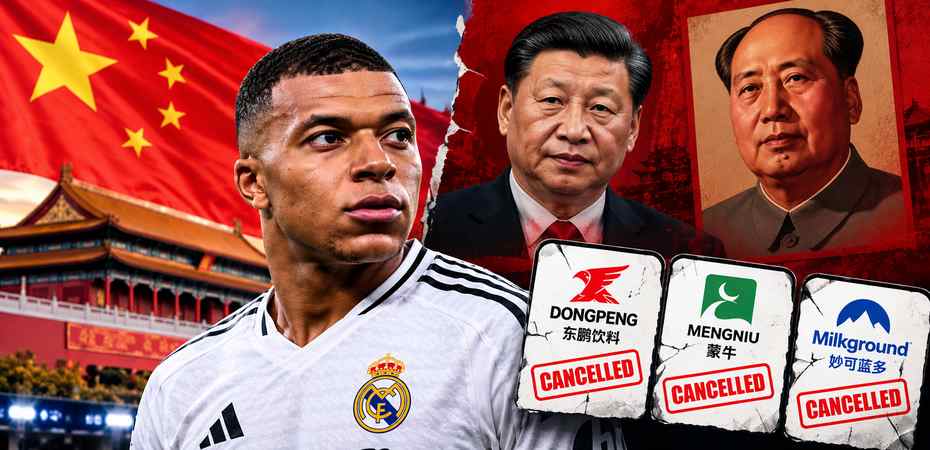
China has responded to an apology from French football star Kylian Mbappé following a controversy over remarks about a viral internet meme featuring Mao Zedong. The incident has drawn attention to the commercial risks international celebrities can face when their public comments are considered offensive in major markets.
Chinese Foreign Ministry spokesperson Guo Jiakun said Wednesday that authorities had taken Mbappé’s expression of regret seriously. However, it remains uncertain whether the apology will be enough to restore the business relationships affected by the dispute.
Chinese Companies End Sponsorship Agreements
The controversy has already had financial consequences for Mbappé. Three Chinese businesses—beverage producer Dongpeng, dairy company Mengniu and cheese manufacturer Milkground—announced that they were ending their agreements with the footballer.
The companies cited their opposition to conduct they believe harms national sentiment. Their decisions followed criticism of comments Mbappé made during an online interview.
The developments illustrate how quickly a controversy involving a global sports figure can affect commercial partnerships, particularly in markets where companies place significant importance on national identity and public reputation.
What Mbappé Said About the Meme
The incident began when Mbappé was asked to identify his favourite meme featuring himself. He referred to an image of a man he believed was a Chinese dictator, after which the video showed a digitally altered picture placing his face onto Mao Zedong’s body.
The image was part of a wider internet trend in which football fans jokingly portray Mbappé as an authoritarian leader. These memes are circulated in online football communities, often exaggerating the player’s influence over his teammates and clubs.
However, the reference triggered a backlash in China, where Mao remains a historically significant and politically sensitive figure.
Mbappé Issues a Public Apology
Mbappé subsequently acknowledged that his remark had been poorly judged and expressed regret for offending people in China and Chinese communities elsewhere.
He also emphasised his respect for Chinese people and their history, explaining that causing offence had not been his intention.
The apology followed criticism from Chinese media and businesses. Whether it will lead to the reinstatement of sponsorship arrangements remains unclear.
Broadcasting Restrictions Add to the Fallout
The controversy has extended beyond commercial endorsements. China Media Group announced that it had suspended broadcasts of matches involving Mbappé, including games in Spain’s domestic league, and called for apologies from the player, his club Real Madrid and La Liga.
La Liga president Javier Tebas issued an apology on Tuesday, reaffirming the league’s commitment to maintaining its relationships with Chinese partners.
Real Madrid also expressed regret over the incident on Wednesday and reiterated its respect for the Chinese people. China Media Group confirmed receiving the club’s apology but did not provide further details.
These responses demonstrate how a dispute involving an individual player can become a broader issue for sports organisations, broadcasters and commercial partners.
Why Mao Zedong Remains a Sensitive Figure
Mao Zedong led the Chinese Communist Party to victory in the civil war and became the founding leader of the People’s Republic of China in 1949.
His historical legacy remains deeply complex. While Mao is still revered by many people in China, his rule also included campaigns associated with widespread suffering and millions of deaths, including the Great Leap Forward and the Cultural Revolution.
That history helps explain why imagery involving Mao can carry political and cultural significance beyond its use in internet humour.
A Wider Lesson for Global Brands and Celebrities
The episode highlights the challenges international celebrities face when their public image intersects with cultural and political sensitivities in overseas markets.
China represents an important commercial market for international entertainment and sports. Sponsorship agreements, broadcasting arrangements and consumer relationships can all be affected when a public figure becomes the centre of a controversy.
The incident also shows how social media humour can be interpreted differently across audiences. A meme intended as a joke in one setting may be viewed as disrespectful in another.
For Mbappé, the immediate question is whether his apology will help repair the damage to his commercial relationships. For companies and sports organisations, the controversy serves as another reminder that managing a global reputation requires an understanding of local history, public sentiment and cultural expectations.
The long-term consequences remain uncertain, and the available information does not establish whether the terminated brand agreements or suspended broadcasts will be restored.