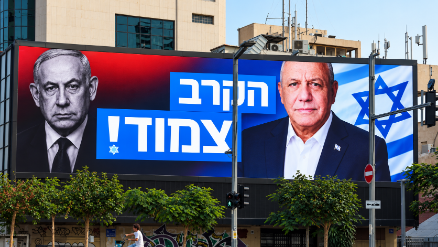
Early vote estimates indicated that Netanyahu’s political alliance could secure around 56 seats in the 120-member Knesset, while the opposition grouping led by former military chief Gadi Eisenkot was projected to win approximately 48. Arab-led parties were expected to capture another 16 seats, potentially making them influential in negotiations over the next government.
Eisenkot claimed a political breakthrough after preliminary exit polls initially showed his alliance narrowly ahead. He argued that the early figures reflected declining public support for Netanyahu’s leadership following the October 7 attacks and the subsequent conflict.
However, exit polls and partial projections do not determine the final outcome. Official results were scheduled for release on November 4, while reported voter participation reached approximately 77.7% — the highest turnout in a Knesset election in nearly three decades, according to election authorities.
Government Bond Yields Climb
Israeli government debt weakened as investors assessed the uncertainty surrounding the election outcome. Yields increased across several maturities, reflecting selling pressure in the bond market.
The two-year government bond yield rose by six basis points, while the benchmark 10-year yield advanced four basis points. The yield on 30-year bonds increased by two basis points.
Bond prices move inversely to yields, meaning the increase in yields indicated a decline in government bond prices.
The shekel also weakened as markets reacted to the possibility of extended coalition negotiations and continued uncertainty over Israel’s political direction.
Coalition Talks Could Determine the Outcome
The election represents a major test of Netanyahu’s political standing after years of dominance and a period marked by the October 2023 Hamas-led attacks and subsequent military campaigns in Gaza, Lebanon and Iran.
Neither major political camp appeared positioned to secure the 61 seats required for a parliamentary majority. Under Israel’s political system, the president generally assigns a lawmaker the task of forming a government, usually choosing the candidate considered most capable of building a governing coalition.
If negotiations fail within the required timeframe, the country could face another election.
Netanyahu’s supporters argue that his leadership has helped Israel confront security threats and resist international pressure. His opponents cite his corruption trial, proposed judicial changes and management of the Gaza conflict as reasons for seeking a change in leadership. Netanyahu has rejected the allegations against him and the International Criminal Court warrant concerning the Gaza campaign.
Arab-Led Parties Could Hold the Balance
The projected performance of Arab-led parties emerged as a significant factor in the post-election negotiations. Ra’am leader Mansour Abbas indicated that his party’s representation could influence the composition of the next government. Ahmad Tibi, a senior figure in the Joint List, has also discussed efforts to prevent Netanyahu from remaining in office.
Analysts suggest these parties may find greater political alignment with the opposition than with Netanyahu’s coalition. Nevertheless, ideological differences and disagreements over security policy could complicate any attempt to build a stable parliamentary majority.
Even if Eisenkot’s alliance secures more seats, forming a government may require support from Arab-led and left-wing parties. Such an arrangement is not guaranteed, and the next government’s approach to Iran, Palestine and national security could remain largely unchanged if coalition negotiations fail to produce a substantial political shift.
Avigdor Liberman, leader of Yisrael Beytenu, has opposed relying on Arab parties to establish a governing majority, creating another obstacle for the opposition camp.
During the election campaign, Netanyahu and far-right allies also warned about increased participation by Arab voters. Opposition figures criticised those remarks, accusing the prime minister of using divisive rhetoric.
Prolonged Deadlock Remains Possible
Netanyahu has previously survived repeated electoral stalemates, with rival parties struggling to assemble a coalition before political deadlines expired. Israel experienced five national elections between 2019 and 2022, illustrating the difficulties of forming stable governments under its parliamentary system.
Analysts expect negotiations to continue after the final results are confirmed. Netanyahu could use the coming weeks to seek coalition partners, challenge the opposition’s efforts or delay a decisive transfer of political power within the limits of the parliamentary process.
The election therefore does not automatically signal the end of his leadership. The final distribution of seats, the position of smaller parties and the ability of rival blocs to secure 61 votes will determine whether Israel experiences a change of government or another period of political paralysis.